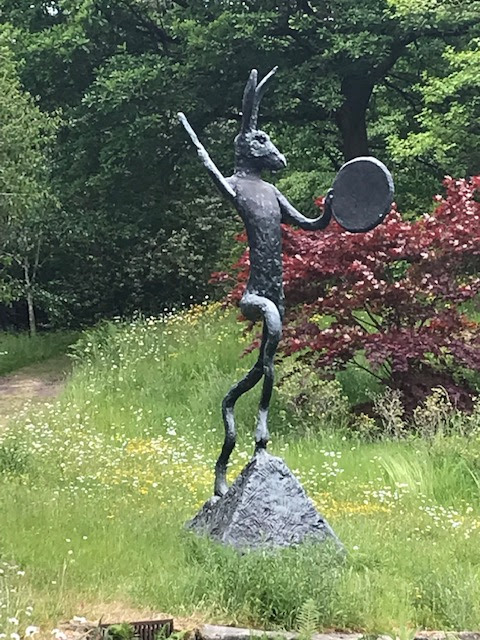
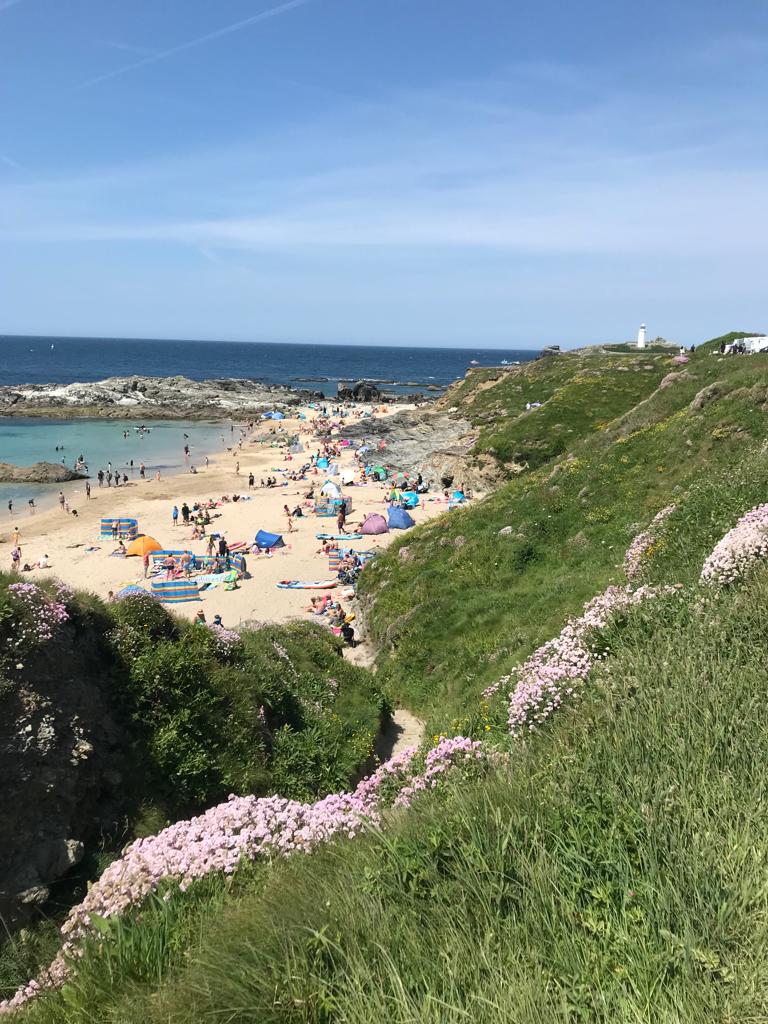
We returned to Blore Hall for a refreshing swim in the beautiful pool which has some lovely illustrations which reminded us of our walk.
After watching Secrets of the National Trust on BBC 2 we decided to visit Biddulph Gardens. A trip around the world at a National Trust garden. June is a lovely time of year to visit with the rhododendrons in full bloom which was spectacular. The gardens are well laid out and, of course, the China garden a delight now that the restoration of the bridge is complete (which we watched on the above programme).
Located in Biddulph, to the north of Stoke-on-Trent in Staffordshire, Biddulph Grange Garden is a unique Victorian garden. It was created by James Bateman to display his excessive collection of plants from around the world. Restoration works started in 1988 after the National Trust took ownership. Today, the 15 acres landscaped garden is divided into different themes such as Egypt, China and Italy. One minute you're in China then the next you're entering a tomb-like tunnel in Egypt. These sections are cleverly divided in a unique way by using tunnels rocks and shrubs which add to the element of surprise.
We had also planned to visit Little Moreton Hall (National Trust) which is quite close but, unfortunately, it was closed. Apparently NT properties have to rest for two days every year and we chose a day when it was resting!!!!! (I suspect they are probably checking the structure of the building).
The gardens at Blore Hall, where we were staying, were beautiful too.
But one of the attractions at the top of my list was Chatsworth and after three attempts (Covid) we finally had the opportunity to visit it. Chatsworth is one of the grandest country houses in England, popularly known as the 'Palace of the Peak'. The Elizabethan house, built in 1555 by Bess of Hardwick, was virtually replaced with the 1st Duke of Devonshire's baroque mansion of the late 17th century, finished by the 6th Duke in the 1820s. In fact, we went out of our way to see it and it was very much worth it. We booked a slot (10.15 am) online. We wanted to get to the house as soon as it opened to the public so we would avoid giant crowds. The drive from Blore Hall was a beautiful drive through hills and valleys. We quickly fell in love with the Derbyshire dales. They did not fall in love with us though as it was really cold for a June day. The drive to Chatsworth was quick - natural beauty has a way of making the time pass without notice. We arrived at Chatsworth pretty early - about 30 mins before it opened. It's quite something to come up the main drive and see the house, it's warm golden stone glowing even in the dreary grey skies. We immediately saw that many others had the same idea as us. The car park was half full and the place wasn't even officially open yet. But as we were one of the first to enter the house we were able to pretty much have the place to ourselves. This was surely my Elizabeth Bennett moment, snooping around Pemberley. In Pride and Prejudice, Chatsworth was used as Pemberley, the residence of Mr. Darcy. It is still the home of the Duke of Devonshire and his family.

I will cherish my collection of photos free of fellow travellers. The house was quiet, you could hear a pin drop. It lent a very civilized air to the proceedings of seeing a great house. You enter through the Painted Hall - probably the most famous work of art at Chatsworth and it is truly something amazing to see in person. It was an even better treat to have it almost to ourselves. We marvelled at the ceilings and walls. Stunning. I don't have the words to adequately describe it.
There were attendants in each room, happy to answer questions. There were some surprising discoveries - such as the room that had a Rembrandt in it - a beautiful painting that caught us completely by surprise.
The house is filled with beautiful works of art. The art collection has been kept intact and did not meet the fate of other stately homes and get auctioned off. It's quite something to be in the presence of so many original and beautiful works of art. As we made our way through the house, we had most of the rooms to ourselves and the staff members were very friendly and engaging. Don't miss the trompe l'oeil of a violin and bow hanging on a door (Jan van der Vaardt (1653-1727), oil on panel. Trompe l'oeil (French for 'deceive the eye') is an art technique that uses very realistic imagery to create the optical illusion that the object depicted is actually three-dimensional. In this case, the painting itself is set into an actual door, and the painted violin appears to hang from a real metal peg on the door itself. AMAZING.
My favourite room was probably the library. I love books and this library has over 30,000 volumes. It is one of the largest collections still in private hands. A true treasure. One can imagine the Duke having a quiet evening reading some random book from his shelves, lovely dogs at his feet and a fire roaring the hearth. Notice how the carpet matches the ceiling.
The gardens at Chatsworth are sizeable, coming in at 105 acres. Put it this way; there's plenty to walk around. The gardens include the greenhouses and kitchen gardens. Decent paths weave around the length of the garden, taking you through an arboretum, pinetum and a maze, and over a ravine if you choose. And lots of statues.

We even thought this tree stump looked like a rabbit....
Although Capability Brown landscaped the grounds, their crowning feature is Joseph Paxton's stunning Emperor Fountain at 260 feet.
When you leave take a look at the golden stone village of Edensor. Before 1839 the village lay in full view of the big house, so the 6th Duke had Paxton demolish it and rebuild it out of sight.
En route home we stopped at Bakewell, best known for a confection made by mistake. In the 19th century a cook at the Rutland Arms was baking a jam tart but misunderstood the recipe and so Bakewell Pudding was created.
We enjoyed wandering through the old-fashioned streets, picturesque archways, by the side of the river, looking for the giant trout, and across Bakewell Bridge. Don't forget to pick up some Bakewell pudding or tarts for later!
For a complete change the next day we drove through Winnats Pass, the name is a corruption of 'wind gates' due to the swirling winds through the pass. An amazing drive. A protected site, this is because the limestone valley is full of fossils from the sea creatures who inhabited the tropical sea that the valley was once beneath.
Set at the foot of the spectacular Winnats Pass, high above the village of Castleton is Speedwell Cavern which takes you on an underground boat journey. We descended the 105 (I think) steps from the almost hidden cavern entrance to the landing stage of an underground canal where you step on to your tour guide boat. From here you glide through the workings of a 200 year old lead mine. Not pretty. Picture in your mind what it must have been like to carve out these tunnels using only the most primitive tools as your guide recounts the story of the mine on our journey to the awesome Bottomless Pit. The tour guide was great and had the perfect sense of humour.


Castleton is a pretty Peak village. If you're feeling fit, you can climb the steep steps up to the atmospheric Norman ruins of Peveril Castle, completed in 1086 for William Peverel, a favoured knight of William the Conqueror and then reward yourself with a delicious homemade steak pie with mash and vegetables, with a good range of hand-pulled draught beers, at Ye Olde Cheshire Cheese Inn. A 17th century coaching inn.
Quite close is another of Derbyshire's prettiest villages Eyam (pronounced "eem"), though its idyllic patchwork of Peak District cottages around a country church belies its dark past. Eyam secured its place in the history books in 1665, the year of the Great Plague in London, a chest of clothes was sent from the capital to the village. Soon four out of every five villagers were dead. But what made Eyam special was the extraordinary sacrifice that these villagers made. Led by the rector, William Mompesson, they resolved to isolate themselves and prevent the disease from wiping out neighbouring communities. We joined a guided walk at 1.30 p.m. from the museum which was very interesting.

During May to September in Derbyshire, the unique spectacle of Well Dressings takes place - a custom that celebrates water and the life it brings. Many villages have revived this ancient tradition and create living art installations to decorate their wells, often combining it with local carnivals and other festivities.
Well Dressings are pictures made from growing things (wool, bark, cones, flower petals, berries, leaves, seeds and other natural materials), constructed on a bed of soft clay spread over a wooden board and erected at the site of the spring or well.
Well Dressings depict a wide range of themes from bibical stories, historic themes and natural history to Disney characters! Dressing a well can take a team of skilled people up to a week to produce. The finished well will only last a week or so, as the flowers fade and the clay dries out and cracks.
We visited four Well Dressings at Ashford-in-the-Water to marvel at this age-old unique tradition with a superb show of artistic creativity.
The Holy Trinity Church at Ashford-in-the-Water also had a Flower Festival with the Theme: 'Children's Storytime'. A beautiful church building with amazing flower displays. Well done.

Snake Pass slithers across the Pennines between the market town of Glossop and Ladybower Reservoir's Y-shaped valley. Just wow! The twists and turns of Snake Pass take you though a truly amazing area of beauty. You can see why Snake Pass is often closed during winter months but this was such a delight to drive during summer. Mention 'Ladybower' to anyone over 50 from Yorkshire or Derbyshire and they'll tell you enthusiastically that this is where the 1955 classic Dam Busters was filmed. The reservoirs of the Peak District's Upper Derwent Valley played a key role in the most famous bombing raid of the Second World War - today they are popular and peaceful spots, best explored on foot with a six-mile walk. Start at Fairholmes Visitor Centre, north of the A57 Glossop to Sheffield 'Snake' Road. You can drive between the Towers to a turnaround at King's Tree, from where there is a fantastic view of the Derwent Dams. Note: This road is closed throughout the year at weekends and bank holidays.


A family tale, Bess of Hardwick. - A story of Lords and Ladies, Earls and Dukes, woven around the great houses of Hardwick, Chatsworth and Bolsover. Our next visit was to Hardwick Hall.. It all started in 1527 when a girl was born in a small manor house at Hardwick. Named Elizabeth, she was left just £26 13s 4d when her father died, and she embarked on the only career open to her - marriage! Elizabeth's first husband died after just a few months but her second marriage, to Sir William Cavendish, lasted 10 years
William was extremely rich, owning property in 5 counties - but he sold it all to move to the place his wife loved best, Derbyshire. Here, he bought new land including, in 1549, the house and estate of Chatsworth. After her husband's death in 1557, Elizabeth married Sir William St Loe who left much of his wealth to her, despite his family's anger. Her 4th marriage to the Earl of Shrewsbury made her almost as rich as the Queen, and with more than enough money to buy her old family home, Hardwick. The first thing Elizabeth did was replace the small manor house where she'd been born with a great hall, known today as Hardwick Old Hall. It was here that she lived after a bitter argument with her husband.
They were never reconciled and, on his death in 1590, Elizabeth laid the foundations of her last and greatest house. Hardwick Hall was the result of the Elizabethan fascination with symmetry and glass. Perfectly symmetrical on all 4 sides, the Hall has so many windows that it started a local rhyme - "Hardwick Hall, more glass than wall"! Each of the Hall's 6 towers is crowned with the initials ES and the coronet of the Countess of Shrewsbury and, in 1597, Elizabeth moved into her new home. More than 350 years later, her descendants were forced to sell the Hall to pay death duties and it's now owned by the National Trust.
I have never seen so many tapestries on walls and of great quality. There is an amazing frieze too. The Long Gallery is crammed with tapestries and paintings. The Grade 1 listed park is great for a walk to stretch your legs after all this history and the walled garden perfect for a picnic lunch.
On our way back to Blore we stopped at Carsington Water for a walk and an ice cream.
On the last day of our holiday in the Peak District we visited Lyme Park run by the National Trust. We arrived early and clambered up a sloping hill to see The Cage and the views from up there. We then followed the route down towards Lyme Hall, so we could wander around the house. It is home to the world's very first printed manuscript! The house itself is splendid and we also booked for the "background" tour at 12.30, tickets are picked up from the ticket office situated within the main courtyard of the house. We got to see the butler's rooms and behind the scenes. The guide was very informative and had lots of stories. It was so interesting to see and learn all about the servants and what it would have been like to work in the house all those years ago.


The house was used as a setting for the period drama "Pride and Prejudice". You may recognise the lake that forms part of its gardens as the location where Colin Firth famously shot the scene in the 1995 BBC version of Pride and Prejudice in which Mr. Darcy goes for a swim, and to Elizabeth's surprise emerges soaking wet from head to toe. The house is amazing - lots of tapestries, woodcarvings, collection of English clocks and also there are some of the original Elizabethan interiors. After our tour around the house we decided to take a look around the large acres of gardens that surround it. The first thing I noticed on entering the rear of the house was the large reflective lake with many beautiful Rhododendrons surrounding it. There is also a deer park. After that, we wandered around the surrounding gardens, which include walled gardens, an Italianate garden, orangery and more. We certainly didn't see absolutely everything in the estate. That would surely take a full day or perhaps even longer!

So much in the Peak District we didn't get to visit. Perhaps, for another time in a county where all the attractions - both natural and manmade - are truly timeless.
And the beer is cheap up North too. Cheers.