Monday, 7 September 2020

Back to School

 It's more than 160 days since schools sent home pupils at the beginning of the lockdown.  No-one at the time, in those bewildering March days, could have known when children would return.

The leaves that were starting to appear on the trees when children hurried home are now about to turn brown.  It's been a long and strange summer.  The family holiday was cancelled.

Exams were cancelled and there were replacement results.  And then those results were cancelled too.  There was constant confusion over whether or not pupils were going back to school.

Home-schooling didn't always really happen and rites of passage such as leaving events had to be called off.  There were more u-turns than a handwriting text book.

But children are now going back full-time for the new school year.  The "new normal" became a lockdown cliche, but going back to school in September is a rare case of the old normal.


So what's it going to be like for these returning pupils?  What should parents be saying to them?  Are they going to be able to get back to learning after months of lie-ins and Netflix?  I think there's a real need to recognise the physical, mental and emotional impact of going back.  But on the other hand, there were positive experiences during lockdown.  They have not had the stresses of school and they have enjoyed spending more time together with their parents, especially Daddy. The lockdown saw a temporary reinvention of family life, with those parents working from home seeing more of their children than would ever usually be possible.  Perhaps children and perhaps also their parents will miss this closeness.

Follow the lines; join the queue; please keep your distance and wash your hands.  I am sure the schools will institute a regime of hygiene and precautions to keep pupils safe.

Thursday, 3 September 2020

A Day Out at the Needles

 The Needles is one of the most beautiful spots on the Isle of Wight and perhaps it's most famous landmark.  After living in Milford-on-Sea for nine months the grandchildren were desperate to visit.


The Needles is a row of three distinctive stacks of chalk that rise out of the sea off the western extremity of the island and is a must see.  Actually, there used to be four stacks, but one of them collapsed during the great storm of 1764 - one of the tallest Needles in the famous rock formation - all that is left of it today is a large gap.  The formation actually takes its name from the fourth needle-shaped pillar called Lot's Wife.  The remaining rocks are not at all needle-like, but the name has stuck.


The Needles Lighthouse stands at the outer, western end of the formation.

There are a few ways to see this famous landmark.

We boarded the 10 am Lymington to Yarmouth ferry.  It's an attractive trip sailing down the Lymington River and across the Western Solent.  The crossing took 40 mins and we had good views of all the sailing boats through the big windows.

We then headed for The Needles - Landmark Attraction (previously known as The Needles Pleasure Park) situated at the top of the cliff at Alum Bay and is a small amusement park. Parking costs £6 for all day or £4 if you show your National Trust card. We started our day with a trip from the top of Alum Bay cliffs down to the beach below.  Spectacular views of the picturesque Needles Rocks and Lighthouse as well on the chairlift which operates between the park and the beach.  (You can walk down lots of steps instead).  It was nice and quiet when we arrived and it was great fun, especially the drop over the cliff with fabulous views.  Chloe thought it a little scary!!  I have to say it's not for the faint hearted.  The staff were fab with helping the children on and off - they had to wear masks because of this. 


  The beach is stony at the bottom but the colourful cliffs are very interesting and unusual to see.  You can take a boat ride to The Needles.


Safely back at the top Chloe and Jamie opted for a Dino Jeep Ride.  Well the Isle of Wight is also known as Dinosaur Island.


Our car was parked by some grass with lovely views so this is where we chose to eat our picnic.

Because of the Corona Virus our visit to the National Trust Needles Battery had to be pre-booked (we were 2 p.m.) so there was time for a game of Jurassic Crazy Golf before the mile walk up to the top of the cliff to look down onto the Needles.


The walk is incredibly picturesque and leads you to the National Trust Needles Battery.  A former military installation where rockets were once secretly tested.


The Needles' pointed shape is a result of their unusual geology.  The strata have been so heavily folded during the Alpine Orogeny that the chalk is near vertical.  This chalk outcrop runs through the centre of the Island from Culver Cliff in the east to the Needles in the west, and then continues under the sea to the Isle of Purbeck, forming Ballard Cliff (near Swanage), Lulworth Cove and Durdle Door.  At Old Harry Rocks (east of Studland and north of Swanage) these strata lines moving from horizontal to near vertical can be seen from the sea.

Just off the end of the Needles formation is the Shingles, a shifting shoal of pebbles just beneath the waves.  The Shingles is approximately three miles in length.  Many ships have been wrecked on the Shingles.

Such an enjoyable day and the visibility was superb.


Monday, 31 August 2020

The Evil Weever Fish

 Emmie has been learning to surf this summer and she was just showing Nanna how good she is getting when she thought she had just stood on a rock and cried out in agonising pain.


A lifeguard realised pretty quickly what had happened.  The pain set in rapidly and Emmie was screaming.

You have trodden on an evil weever fish and your first and only aim is to get your foot in red hot water, as hot as you can stand, as the poison is protein based and its destroyed by heat.


The symptoms vary but involve excruciating pain.  Apparently as you sit and wait for the kettle to boil the pain really sets in and you can't focus on anything else but the pain, even grown men cry.  Poor Emmie.

Slowly though the pain did subside and we would like to thank the wonderful lifeguards at Branksome Beach in Bournemouth for their quick response.  Emmie now wants to be a lifeguard, but first we had better buy some surf boots.


The small fish have been drawn to UK shores by the recent heatwave and lurk in shallow water.  The creatures bury themselves in the sand for camouflage, making it hard for sun-worshipping Brits to spot them.  If trodden on the spines unleash a powerful venom that can cause excruciating pain.


Wednesday, 19 August 2020

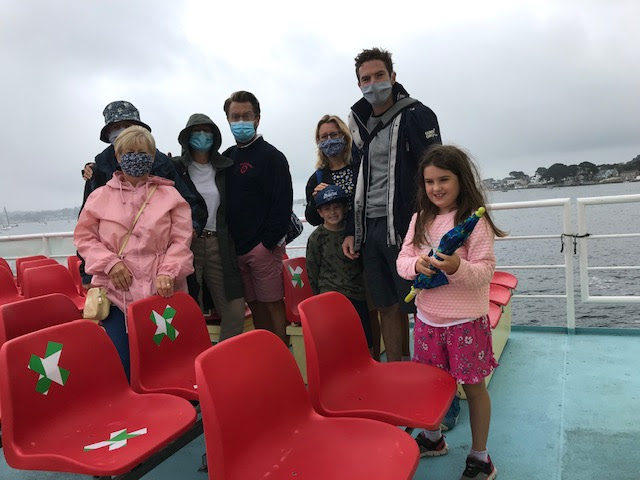
Birthday trip to Brownsea Island

For my birthday  the family very kindly treated me to a picnic on Brownsea Island.  Marooned in the midst of Europe's largest natural harbour, Brownsea is a natural treasure.

Twenty minutes by ferry from Poole Quay, National Trust-owned Brownsea is an Enid Blyton hideaway - it inspired the Famous Five's adventures on Whispering Island.  But it's perhaps best known as the birthplace of the Scout movement: in 1907 , Lord (then plain Major) Baden Powell brought a group of 20 boys here to take part in an experimental camp, living close to nature and practising practical skills he had learned in the army during the Boer War.  It launched a global movement, and before the corona virus groups from 75 countries visited the island each year. 

To ensure social distancing everyone visiting most book both their ferry ticket and admission pass in advance and you have to wear masks on the ferry even if outside.  And you are only allowed a four hour visit.


Upon arrival we wander into the forest but it is only walking back to the ferry when Grandad spots a red squirrel - Brownsea is home to one of England's last colonies.  Lots of friendly peacocks too, including a mummy and babies.


 Despite its size - just one and a half miles long and three-quarters of a mile wide - Brownsea has wide-ranging habitat, from heathland to sheltered lagoons and woodland with more than 100 tree species.  For kids, it's an adventure playground with a tree climbing route and a natural play area.

The tree trail at Brownsea is a climber's dream. With a trail taking you around the island and trees marked by a sign, it is easy to get a squirrel's eye view of Brownsea Island.  There are some tricky ones and some easier ones and some that have fallen over and make great balance beams.  You can also find out more about some of the different types of tree.  Watch out for the Holm oak.

There is also a Play area made from natural resources and is designed so that children can try their hand at some of the balancing, climbing and jumping that the island's resident red squirrels can often be seen doing.  The grandchildren absolutely loved their visit.

So many colourful characters have shaped the island.  Henry VIII built the castle in the east (now leased by the John Lewis partnership as a hotel for its staff).  I love the tale of Colonel William Petrie Waugh and his wife Mary, who bought the island in the 1850s thinking they'd found a source of high-quality clay and built a pottery, village and church, but fled to Spain bankrupt when the material proved substandard.  There was bon vivant tobacco baron Charles van Raalte, who used it for holidays and insisted all employees played an instrument, and whose widow turned the whole place into a daffodil farm.  In the 1920s came reclusive Mary Bonham-Christie, who banished all inhabitants and let nature take over.  During the second world war the island served as a decoy for Poole, with pyrotechnics tricking Nazi bombers into targeting Brownsea instead.

What a great day out!  Despite the weather being less than ideal, it's a real escape from reality.  No shops at the moment so we took a picnic.  Then on our return it was fish and chips, ice cream, birthday cake and bubbles.  What more can a girl want?

Also spoilt with some beautiful flowers.  Thank you everyone for a fabulous birthday.  


 I remember all 15!!!!!!!!!!